
Welcome to the Era of the
informed patient.
Spine problems are notoriously hard to pin down. SpineSense is where you gather your symptoms and records in one place, read a plain-language summary of what they describe, and send that history ahead to the specialist you are seeing before you step into the clinic.
Educational tool. SpineSense does not diagnose conditions, recommend treatment, or replace an examination by a clinician.
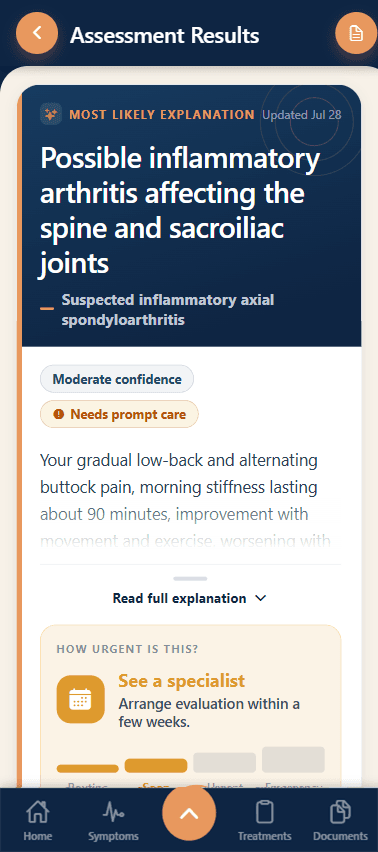
Actual assessment output. Example case, not a real patient.
What People Are Saying
“Not fond of AI (hate it in fact) but out of all potential uses for it, this is a good one. Was so tired of being googled in circles since you can't put all your symptoms into the search bar.”
— Patient & self-described AI skeptic
“This is an AMAZING tool, and as a software engineer it's exactly what I'm hoping AI will be most useful for — the medical field.”
— Software Engineer
Unedited public comments from Reddit. One person’s experience is not evidence of how SpineSense will perform for anyone else, and says nothing about the accuracy of any individual assessment.
“I’ve had back pain for 4 months. I’ve seen 3 doctors. I still don’t know what’s wrong.”
Some version of this is the story we hear most often. Spine pain is complex, and the current system was not built to handle it well for patients.
You can start reading right now. Our education hub covers the spine conditions behind most neck and back pain, and the procedures used to treat them, written for patients rather than for charts.
THE DIAGNOSTIC PARADOX
Two journeys. One should never exist.
The Old Way
Months of appointments before anyone can name it
Pain starts. Confusion follows.
Your back has been hurting for weeks. You don't know if it's serious. You Google symptoms at midnight and spiral between 'muscle strain' and 'spinal tumor.' You have no idea who to call first.
Records scattered everywhere.
Your MRI is on a CD from 2021. Your PCP's notes are in one portal. Your physical therapy summary is a fax somewhere. No one has the full picture, including you.
Generic referral. Long wait.
Your PCP refers you to 'a spine doctor.' You wait weeks for the appointment. You arrive and spend fifteen minutes re-explaining your entire history to someone who has never seen you before.
Left with more questions.
You leave not fully understanding what you were told. You don't know what you should have asked, what comes next, or when to be worried.
SpineSense
Arrive with your history already organised
Tell your story. Once.
Open SpineSense and speak naturally. Describe your pain, when it started, what makes it worse. It is built around spine anatomy, and turns what you say into a structured summary in your own words.
Upload everything. Organized instantly.
Snap a photo of that old MRI report. Paste notes from MyChart. SpineSense reads them, pulls out the key findings, and puts them into one clean, chronological record.
A clearer picture of what's going on.
Read a plain-language summary of the conditions your symptoms and records describe, alongside a body diagram of where you marked your pain and the nerve levels that pattern is usually associated with.
Take it to the right kind of specialist.
SpineSense suggests the kind of specialist usually involved in cases like yours, and can send your intake packet ahead of the first appointment — so you spend the visit discussing rather than re-explaining.
YOUR JOURNEY
How SpineSense Works
From your first visit to walking into your appointment with your history in order. Not ready to start? Read up on what might be causing your pain first.
Describe your pain in your own words
Hit record and just talk. Where it hurts, when it started, what activities make it worse. SpineSense reads medical context and builds your intake from natural speech. Prefer typing? Do that instead.
🎙️ Voice or text, your choiceUpload your records in any format
Old MRI reports, clinic notes, lab results. Upload PDFs, images, or paste text from MyChart. SpineSense reads them and pulls out the key findings automatically.
📄 PDF, image, text all supportedComplete an adaptive questionnaire
It already knows what you've told it, so it only asks what it still needs. No redundant questions. Clinical pathways for your neck, mid-back, or lower back branch based on your symptoms.
⏱️ Typically 8 to 12 minutesRead your personalized summary
See the conditions your symptoms and records most closely describe, in plain language, with how confident the analysis is and how soon it suggests being seen. You'll also get specific questions to raise at your appointment.
📋 Printable and shareable report includedSend it ahead to a specialist
Search for spine surgeons, pain management doctors, or physical therapists near you, and send a one-click packet with your assessment so your first visit starts as a consultation rather than an intake.
📬 Fax or email delivery with confirmationPLATFORM CAPABILITIES
Everything you need. Nothing you don’t.
See What Your Symptoms Describe
SpineSense compares your narrative and uploaded records against surgeon-built clinical guidelines, then explains in plain English which conditions that pattern matches and which kind of specialist usually handles them. Information to bring to a clinician — not a diagnosis.
How Soon to Be Seen
Not all back pain is urgent, and some of it is. Based on what you describe, SpineSense indicates whether your symptoms fall into routine, soon, urgent or emergency territory, so you can judge whether to book an appointment or seek care now.
Longitudinal Pain Journaling
Spine pain is cyclical. Don't rely on memory to tell your doctor how bad it was last month. Log your flare-ups on an interactive body map so you can show your clinician how your symptoms have changed over time.
"What to Ask Your Doctor"
Walk into the exam room prepared. Based on your assessment, SpineSense drafts a tailored list of questions worth raising, so the things you meant to bring up don't get lost in a fifteen-minute appointment.
Your Central Records Hub
Upload PDFs or snap photos of your MRI reports. OCR reads the complex jargon and translates it for you. Keep every record in one pocket-sized, HIPAA-compliant vault.
Red Flag Prompts
If you describe something that needs immediate attention — sudden leg weakness, loss of bladder control — SpineSense stops and tells you to seek emergency care. It cannot catch everything, so if something feels like an emergency, treat it as one.
EDUCATION HUB
Understand your spine before your appointment
Plain-language, sourced explanations of the conditions that cause neck and back pain and the treatments used for them. Free to read, no account needed.
BEING STRAIGHT WITH YOU
What SpineSense is, and what it isn’t
Spine care has enough uncertainty in it already. Here is the boundary, in plain terms, before you spend twelve minutes on an assessment.
What it is
- A place to gather your symptoms, imaging reports and clinic notes into one organised record
- A plain-language explanation of the conditions your symptoms and records describe
- An indication of how soon people with a similar pattern are usually seen
- A tailored list of questions to raise at your appointment
- A packet you can send to a clinician before your first visit
What it isn’t
- A diagnosis, or a substitute for examination and imaging by a clinician
- A recommendation for or against surgery, injections or any other treatment
- An FDA-cleared medical device or clinical decision support system
- A guarantee that a serious condition will be detected — it can miss things
- A way to get emergency care. If something feels like an emergency, call your local emergency number